

A Few Months of Use
A follow-up to my previous post on the SmallRig L-Bracket for my Canon R6mkiii. After several months of using the SmallRig 4160B L-Bracket with my Canon EOS R6 Mark III, I’ve had a good opportunity to assess how well it performs in everyday photography. Overall, it has proven to be a useful addition to my camera setup, particularly when switching between landscape and portrait orientation on a tripod. However, there is one practical limitation worth mentioning, particularly for photographers who regularly use the fully articulating LCD screen on the Canon EOS R6 Mark III.
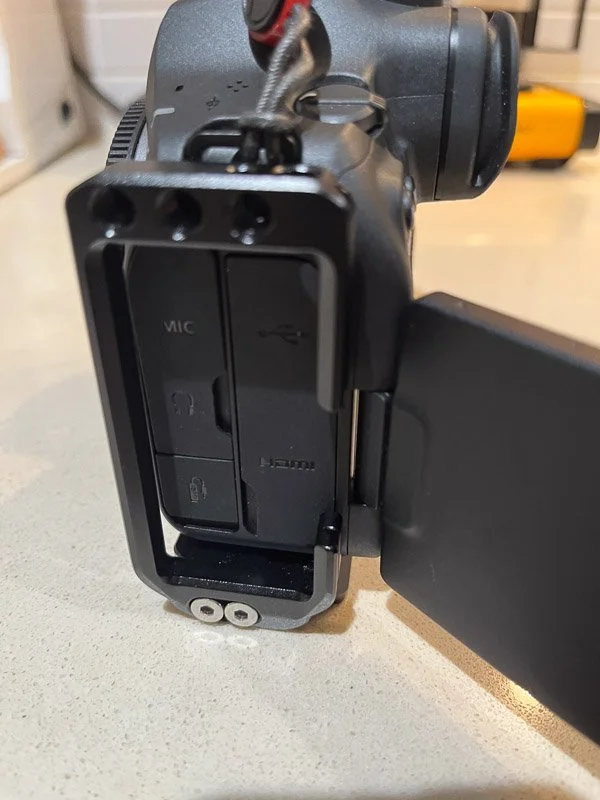
Side view of SmallRig 416B L bracket on Canon R6 mkiii screen open.
Switching Between Landscape and Portrait Orientation
One of the main reasons for using an L-bracket is the ability to switch between landscape and portrait orientation without having to reposition the tripod head or significantly alter the camera’s composition.
The SmallRig 4160B performs well in this respect. Having the Arca-Swiss compatible mounting points on both the base and side of the bracket makes changing orientation straightforward. The camera remains securely positioned over the tripod head, maintaining a more consistent centre of gravity than mounting the camera directly from its base in portrait orientation.
Side view of SmallRig 416B L bracket on Canon R6 mkiii screen open.
For landscape photography, architectural work and situations where precise camera positioning is important, this is a particularly useful feature. The bracket also provides convenient access to the camera’s mounting system without needing to remove it from the tripod every time an orientation change is required.
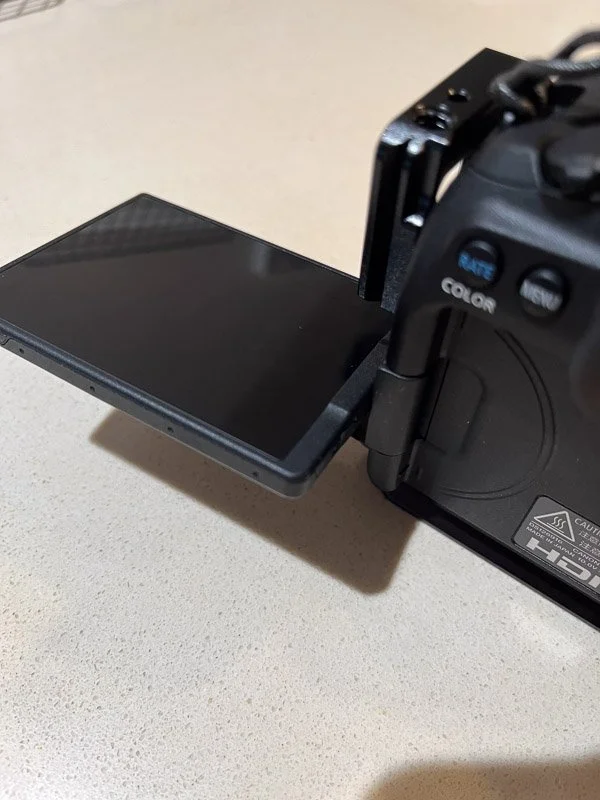
Side view of SmallRig 416B L bracket on Canon R6 mkiii screen flipped out horizontal.
The Limitation: Canon EOS R6 Mark III Flip-Out LCD Screen
The main limitation I’ve encountered after several months of use relates to the interaction between the SmallRig 4160B and the Canon EOS R6 Mark III’s fully articulating LCD screen.
The R6 Mark III features a vari-angle touchscreen that can be flipped out and rotated to accommodate different shooting positions. This is particularly useful for landscape photography, low-angle compositions and working with a tripod.

Side view of SmallRig 416B L bracket on Canon R6 mkiii screen flipped out closer view.
Unfortunately, the cutaway section in the side of the SmallRig L-bracket restricts the screen’s range of movement. Although the cutaway provides some clearance for the LCD screen, it doesn’t allow the screen to articulate through its full range of motion when the L-bracket is attached. In practice, this means the screen can only be tilted and positioned to a limited extent before making contact with, or being restricted by, the bracket.
This is not necessarily a major problem, but it does affect how easily the LCD screen can be positioned when making adjustments in the field. For example, when working close to the ground or adjusting a composition on a tripod, I sometimes need to reposition the LCD screen to get a comfortable viewing angle. With the L-bracket attached, these on-the-fly adjustments are not always as straightforward as they would be without it.

Side view of SmallRig 416B L bracket on Canon R6 mkiii screen flipped out close-up.
Is This a Deal Breaker?
For me, no. The advantages of having a dedicated L-bracket for quickly switching between landscape and portrait orientation outweigh the inconvenience of the restricted LCD screen movement.
The SmallRig 4160B remains a practical and well-designed accessory for the Canon EOS R6 Mark III, particularly for photographers who regularly work with a tripod. However, the LCD screen limitation is something worth considering before purchasing, especially if you frequently rely on the fully articulating screen for composing and reviewing images. Photographers who regularly shoot from unusual angles, use low-level tripod positions or depend heavily on the flexibility of the vari-angle screen may find this restriction more noticeable.
Final Thoughts: SmallRig 4160B L-Bracket for Canon EOS R6 Mark III
After several months of use, my overall assessment of the SmallRig 4160B L-Bracket is positive. It provides a convenient solution for switching between landscape and portrait orientation, offers the benefits of an Arca-Swiss compatible mounting system and has become a useful part of my tripod setup.
The main compromise is the restricted movement of the Canon EOS R6 Mark III’s flip-out LCD screen. While the cutaway design provides some clearance, it doesn’t accommodate the screen’s full range of articulation.
It’s a relatively minor limitation in my photography workflow, but an important consideration for anyone looking to purchase an L-bracket specifically for the Canon EOS R6 Mark III.
My verdict: A useful and practical L-bracket for tripod-based photography, with one design limitation relating to the articulation of the R6 Mark III’s LCD screen. If portrait and landscape orientation switching is a priority, the SmallRig 4160B is still worth considering.
