

Tathra Beach at Sunrise: Photographing the South Coast in the Early Morning
Sunrise creates a quiet atmosphere across the sand, water and coastal vegetation.

Tathra Beach Access Walkway in the warm morning sunlight
Located on the Sapphire Coast of New South Wales, Tathra offers a range of opportunities for landscape and seascape photography. Early morning is especially suited to photography because the low angle of the sun produces softer shadows, warm highlights and longer tonal transitions across the landscape.
For this series of photographs, I visited Tathra Beach around sunrise and explored the shoreline, coastal vegetation, sandy paths and access points leading down towards the beach.
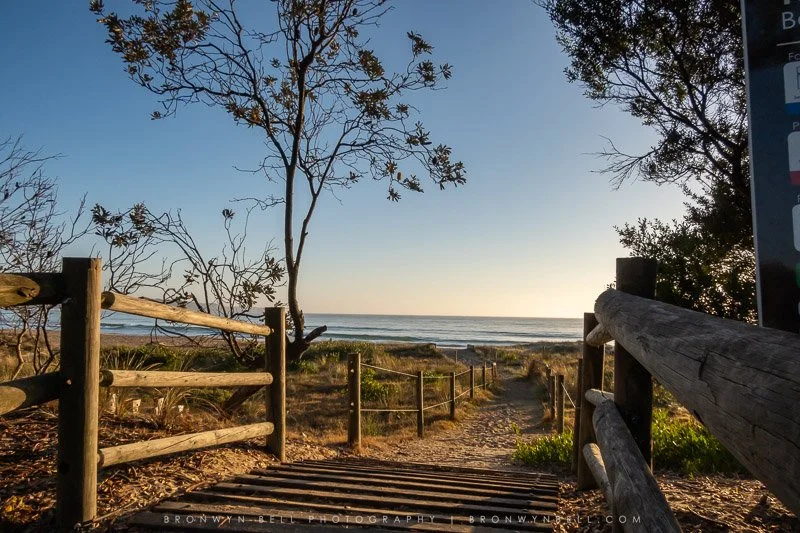
Tathra Beach Access Walking vegetation
Finding Composition at Tathra Beach
One of the advantages of photographing the beach early in the morning is the simplicity of the landscape. The combination of sand, water, sky and coastal vegetation provides a natural series of foreground, middle ground and background elements. I look for foreground elements that can lead the viewer into the photograph. These might include sand patterns, vegetation, footprints, pathways or the edge of the water. The horizon then provides a strong visual reference point, while the sky and changing morning light provide additional depth. Some of the photographs in this series use the coastal paths and timber access structures as leading lines. These elements naturally direct the eye towards the beach and ocean while also providing a sense of location.
Working with Low Morning Light
Sunrise photography can involve a relatively narrow window of useful light. Before sunrise, the scene can appear quite cool and subdued. As the sun approaches the horizon, the light begins to change rapidly. I generally try to avoid making the exposure too bright during these conditions. Protecting the brighter areas of the sky provides more flexibility during editing, particularly when the sun is close to the horizon. A slightly darker exposure can often be preferable because shadow detail can be recovered later in Lightroom, while heavily clipped highlights are much more difficult to restore.
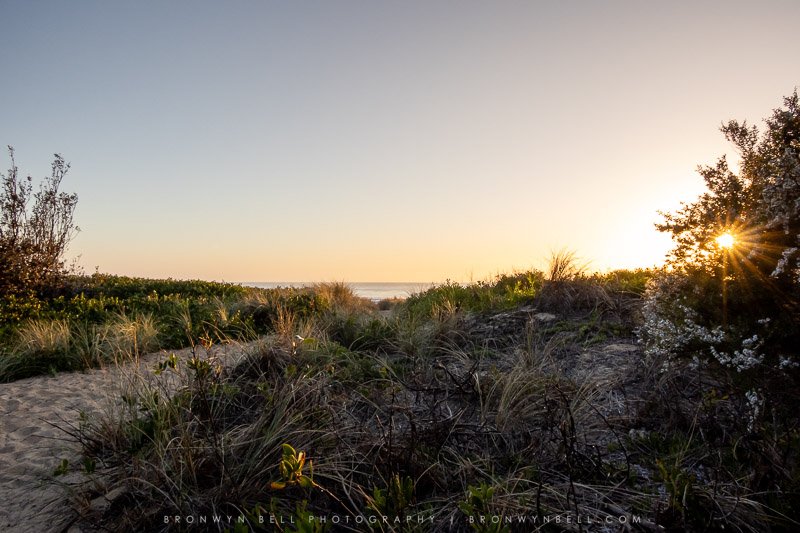
Tathra beach access walking and vegetation - low, warm sun and exposing for the highlights to prevent overexposure.
Lightroom Editing
My Lightroom editing process begins with a relatively conservative approach. The objective is to improve the photograph while retaining the atmosphere and natural appearance of the scene.
Auto and Exposure
I often begin by using Lightroom’s Auto adjustment as a starting point. This provides a useful reference for the overall exposure and tonal balance.
From there, I manually adjust Exposure, Highlights, Shadows, Whites and Blacks.
For sunrise photographs, reducing Highlights can help retain detail in the brighter areas of the sky. Increasing Shadows can reveal detail in darker vegetation and foreground areas.
The Whites and Blacks controls can then be used to establish the overall contrast and tonal range.
Colour
Colour adjustments are particularly important for sunrise photography. The temperature and tint controls can be adjusted to create a natural balance between the cooler shadows and warmer morning light. I generally prefer to retain some of the natural warmth of sunrise rather than pushing the colours too far. Vibrance can also be useful for increasing colour intensity while keeping the overall image relatively natural. Individual colours can then be adjusted using the HSL controls if necessary.
Texture, Clarity and Sharpening
Texture and Clarity can be useful for bringing out detail in sand, vegetation, rocks and timber structures. These adjustments should be applied carefully. Too much clarity or texture can make a peaceful coastal photograph appear harsh. Sharpening is applied after the main tonal and colour adjustments. Lightroom’s Masking control is particularly useful because it allows sharpening to be concentrated on edges and detailed areas rather than smooth areas such as the sky.
Noise Reduction
Low-light photography can introduce noise, particularly when using higher ISO settings or when shadow areas are significantly brightened during editing. Lightroom’s Noise Reduction controls can be used to reduce luminance and colour noise. Again, moderation is important. Excessive noise reduction can remove fine detail and produce an overly smooth appearance. For these photographs, I aim to retain enough natural texture to maintain the sense of detail in the sand, vegetation and coastal environment.
Photographing Tathra at Sunrise
The best time to photograph Tathra Beach depends on the time of year, weather conditions and the position of the sunrise. Arriving before sunrise provides time to walk to a suitable location and observe how the light is developing. Although this morning I was a little late to the party, hence there was little more light and sun already, but at least it was golden sunlight. Cloud can also be particularly useful. Thin or broken cloud can catch the early morning light and provide additional colour and texture in the sky, however, there was very little cloud this morning, so shooting images through vegetation can help to obscure bright and contrast sunlight.
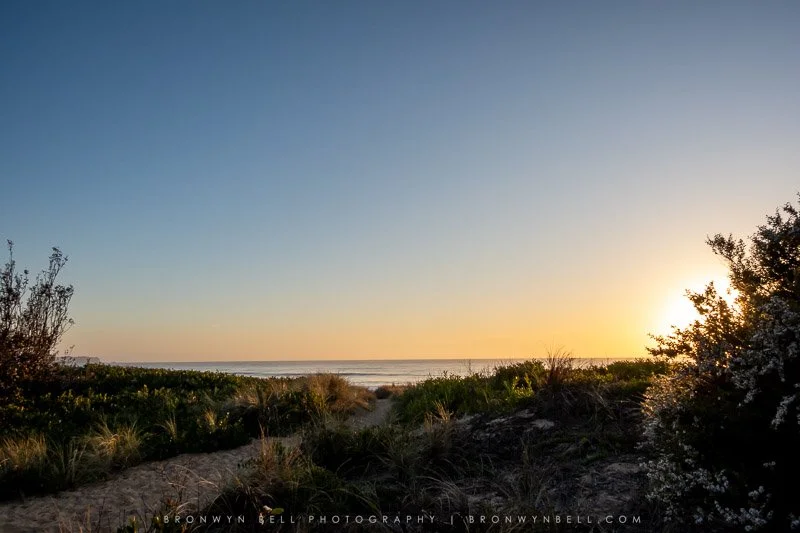
Tathra - no cloud at sunrise but shooting through vegetation can add some interest and remove strong highlights some the sun.
Photography Details
Location: Tathra Beach, Sapphire Coast, New South Wales
Time: Early morning / sunrise
Subject: Coastal landscape and seascape
Conditions: Low morning light
Processing: Adobe Lightroom Classic
Camera: Canon Gx5 mkii
Final Thoughts
Tathra Beach is a rewarding location for early morning landscape photography. The combination of beach, ocean, coastal vegetation, access paths and changing sunrise light provides a wide range of compositions within a relatively small area. For me, the appeal of photographing the beach at sunrise is not simply the colour of the light. It is the quiet atmosphere, the changing conditions and the opportunity to photograph familiar coastal landscapes in a completely different way.
